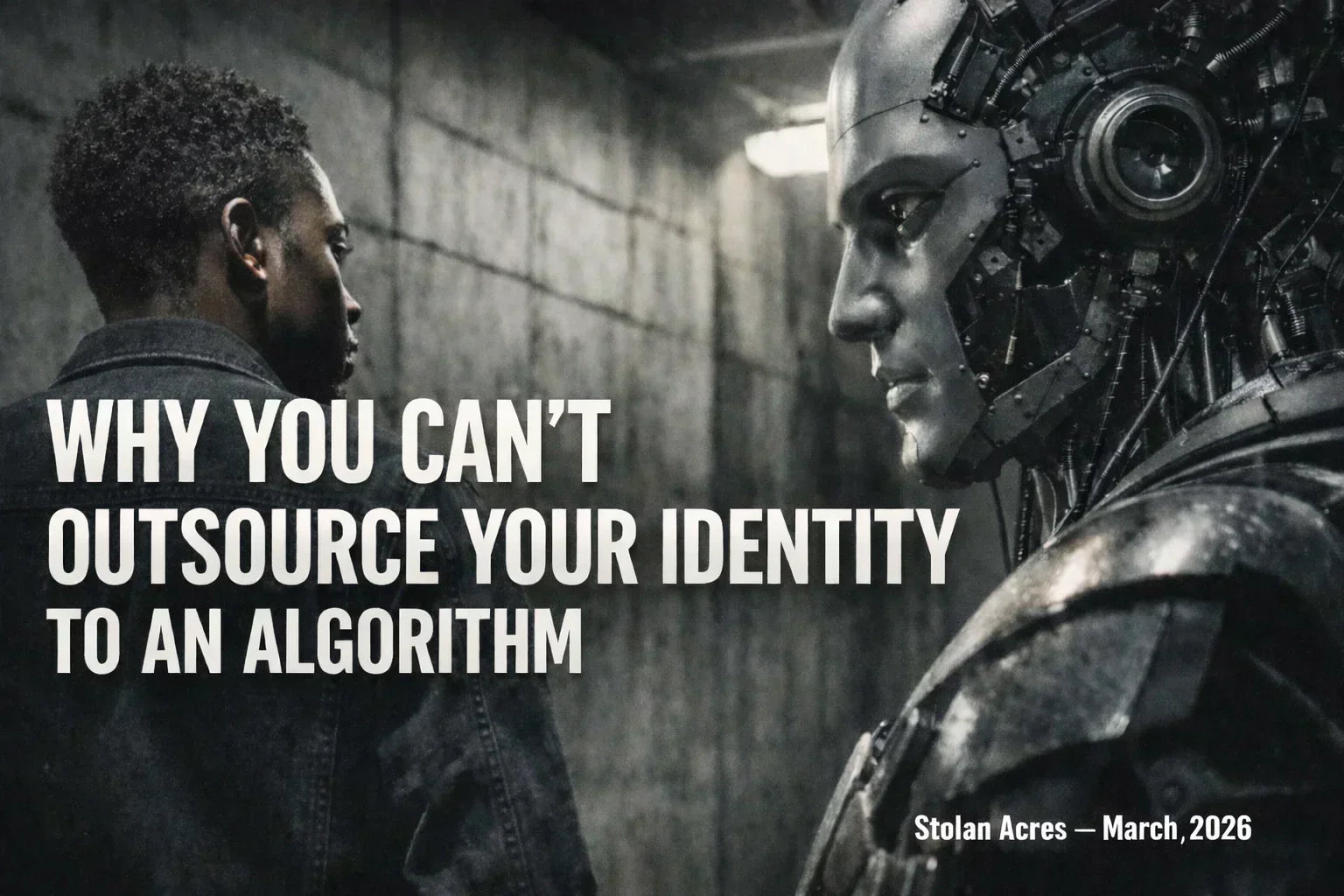
The Supreme Court just did every founder a massive favor. Not by being anti-AI, but by being pro-human authorship.
The high court recently declined to review a ruling that confirms a simple, grounded truth: AI-generated art cannot be copyrighted. To own something legally, it must have human authorship. That is not a rejection of tools, it is a reminder that tools do not make decisions, people do.
This is not just a legal footnote for tech nerds or IP lawyers. It is guidance for every business owner using AI to move faster: AI is a high-speed brush, but it still needs a master painter. The founder's identity is the artist. The business needs direction before it needs more output.
At Stolan Acres, we call the failure mode the "Polished Ghost" problem. Not AI in general, but AI without human identity. Your brand might look sleek, it might look professional, and it might even look expensive. But if it lacks human identity at its core, it is a ghost: no weight, no defensible authorship, no real coherence.
The Illusion of Choice (When You Let the Tool Drive)
We live in an era of preference reinforcement. When you ask an AI to design a logo or write a brand story, it is not looking into the future of who you might become. It is pulling from patterns of what has already happened. It gives you the "most likely" answer unless you provide a clear standard for what is "most right."
Research shows that when we consistently accept algorithmic suggestions, we begin to confuse choice with consent. We think we are making a decision, but we are actually just letting speed replace judgment. AI is excellent at generating options, but it cannot hold your principles, make tradeoffs, or protect your long-term positioning. It is a mirror, not a compass.
If you let the tool drive, you participate in homogenization. You start to look like the average of your competitors, because the tool is optimized for pattern, not conviction. The way out is not to avoid AI, it is to bring your identity to the front of the process and force the tool to execute your intent.

Human Authorship is the Bedrock of Ownership (And the Key to Using AI Well)
Ownership is about more than just a certificate from the copyright office. It is about the "Digital Spine" of your business: the internal clarity that makes decisions consistent across strategy, messaging, systems, and touchpoints. When you build something through the Stolan Acres philosophy, you build identity first, then you use tools to scale execution.
The reason the Supreme Court insists on human authorship is that humans are capable of intention. An AI can generate a thousand images in a minute, but it cannot explain why your brand chooses restraint over noise, why you serve a specific customer, or why you refuse to cut corners. It cannot carry the weight of your taste, your ethics, or your lived experience.
This is the "Spark" that precedes the "System." The Spark is identity, intent, standards, and decision-making. The System is how you execute consistently. AI belongs in the system layer, not the spark layer.
If a competitor decides to lift your AI-assisted brand elements tomorrow, your defense is not "we used a tool," it is "this came from our authored identity, our strategy, our specific decisions." You protect what you can prove you created, directed, and intentionally shaped.

The Real Trap is "Create Something Beautiful" Without a Spine
Many founders reach for aesthetics before identity. They want things to look "clean" or "modern." They use AI tools to generate beautiful mood boards and high-end visuals, thinking the beauty itself creates authority.
It does not.
Authority is earned through restraint and proof. It is built brick by brick. At Stolan Acres, we prioritize clarity over aesthetics every single time. A clear message in a simple font will always outperform a vague message in a stunning image, whether it was made by a human, a tool, or a mix of both.
The issue is not outsourcing execution. The issue is outsourcing judgment.
If you want to move from being a "Polished Ghost" to a true "Brand Builder," you do not need to reject AI. You need to stop using it like a replacement for leadership. Use it like a brush: fast, precise, and powerful, but only in the hands of someone who knows what they are painting.
Brick by Brick: The Operating System for AI-Assisted Branding
So, how do you build a brand that is legally yours and strategically sound, while still moving fast with AI? You follow a process that makes identity the architecture, then uses tools to scale the build.
- Spot: Identify the core truth of your business. What do you believe that shapes every decision? This is your non-negotiable that no tool can invent for you.
- Win: Define what "good" looks like. Not just revenue: alignment, consistency, and trust. AI needs a target, not a vibe.
- Name: Put language on it. Your principles, your standards, your voice rules. This is the human-authored layer that keeps AI from outputting generic work.
- Stack: Build the proof and the systems. This is where AI shines: drafting, iterating, organizing, producing variations, and accelerating execution. This is also where our digital branding tools and executive offerings come into play, we help you stack your identity into a cohesive operating system.
- Reflect: Review with a human filter. Does this output match our spine, our taste, and our promise, or did we let the tool decide?

The Anti-Brander Stance (Updated for an AI World)
The world is full of "branders" who want to sell you a mask: a logo, a catchy slogan, and a template, then call it a day. AI makes this easier. They can churn out "identities" at scale without ever having to understand the human behind the business.
We take the opposite approach. We are identity architects. We believe your brand should be a reflection of your reality, not a distraction from it. AI can be part of that, if it is plugged into a real operating system.
If your brand feels generic, hollow, or easily replaceable, it is not because AI exists. It is because identity never took the lead. True brand authority comes from what is hardest to automate: your ethics, your taste, your standards, and your human perspective.
Your Identity is Still the Asset
In a world where content is becoming a commodity and AI can generate "good enough" visuals for pennies, your unique identity is the only thing that cannot be disrupted. It is the only thing that provides long-term advantage.
When you invest in the human-led process of brand building, you are not just buying a logo. You are building the right to your own story, and the clarity to direct any tool you use.
The Supreme Court ruling is a reminder that the law protects those who create. It protects the builders and the thinkers, and the ones who are willing to author the work, even if they use tools to execute it faster.

The Takeaway
AI can accelerate execution. It cannot replace authorship.
Use AI like a high-speed brush. Use your identity like the artist. Build the Digital Spine first, then let the system, including AI, scale what you already know to be true.
If you are ready to stop wearing a mask and start building a brand presence system you actually own, it starts with an Identity Architecture session. We do not do average. We build the spark, then we build the system.
Don't be a polished ghost. Be a brand builder. Build something that is yours: legally, strategically, and authentically.

-
Key Takeaways:
- Pro-Human, Not Anti-AI: The ruling reinforces human authorship. AI can support the work, but it cannot be the author.
- AI is Execution: Treat AI as a high-speed brush for drafts, variations, and production.
- Identity is Direction: Your "Digital Spine" provides standards, taste, and decision-making so the tool does not steer the brand.
- Polished Ghosts are Tool-Driven: The risk is not AI, it is AI without identity, which produces generic output that is hard to defend and easy to copy.
- The Stolan Way: Spark & System and Brick by Brick act as the operating system for using AI tools with clarity, cohesion, and ownership.


Share:
Branding = Trust = Commissions (CFC Edition)